




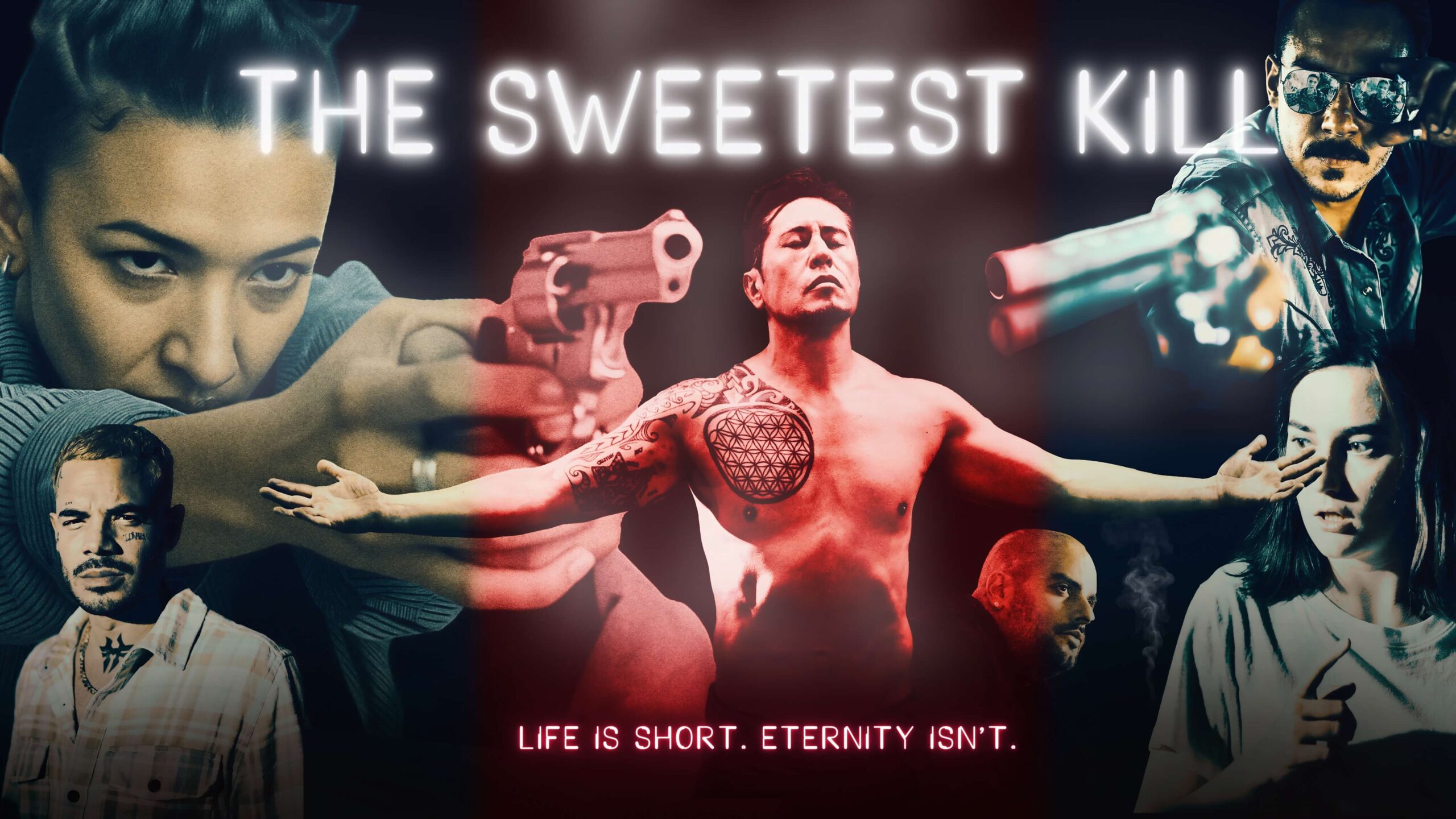
by D. Movieman
“Betrayal is the only truth that sticks.”
― Arthur Miller
Throughout my life, I’ve found it difficult to surmise my perspective on crime. When I
was younger, it felt like a malevolent shadow I prayed would never darken my family’s
doorstep. In adulthood, its very nature continues to confound me. Is it merely a
collection of endlessly recurring actions or an inherent flaw of society as a whole?
Moreover, how does one survive in a world where crime itself functions as an
enterprise? What does it mean to offer loyalty within systems built on disloyalty? Can
trust truly exist in an industry built on violating it? Within this paradox, the narrative of
The Sweetest Kill unfolds.
Directed by Francisco Ordonez, The Sweetest Kill centers itself around Raquel
Pacheco—a former veteran and money launderer who dreams of achieving success as
a music producer. Frustrated with her halted progress, she soon crosses paths with a
hopeful singer named Veronica. What begins as a harmless dalliance between the two
grows increasingly precarious when Veronica’s own criminal entanglements are
revealed. Consequently, Raquel finds herself forced to make costly decisions to secure
a future with the woman she loves. That is, if she can survive the present.

One of The Sweetest Kill’s strongest elements makes itself known immediately.
Considering how modern cinema is often criticized for its depressing desaturation, the
film’s vibrant color palette is a welcome surprise. It’s one that immediately drew me in,
making an impression long before the plot unfolded. It’s especially remarkable
considering the crime genre’s reliance on muted palettes for gritty realism. This creative
choice not only provides The Sweetest Kill with stunning visuals but elevates it into
something more distinctive.
Much of the film’s effectiveness lies in its lead performance. Sofia Yepes embodies
Raquel with layers of toughness, vulnerability, and determination. Yet, as the film
progresses, the emotional threads of her performance deepen significantly. One
particularly memorable scene comes when Raquel reveals her tortured past as a
veteran to Veronica. Despite her guarded persona, it’s a moment of raw, painful
transparency that’s compelling to witness. Eddie Martinez and Rene Rosado also offer
compelling turns as Uly, Raquel’s enigmatic boss, and Efraim, her literal and figurative
partner in crime.

Far less effective, though, is the overall portrayal of Veronica. Many crime films
intertwine elements of love, lust, and obsession, heightening dramatic tension in the
process. Yet, considering the dangerous journey Raquel undergoes to save and protect
Veronica, her character feels rather bland. With underdeveloped writing and a middling
performance from Sidney Flanigan, I found it rather difficult to understand Raquel’s motivations. Consequently, the film’s third act loses some impact, despite a few rousing
twists.
Much like the world Raquel and her compatriots inhabit, The Sweetest Kill is a reminder
that loyalty built on self-interest is fragile at best and deadly at worst. Raquel undergoes
a surprising transformation in her pursuit of love, security, and escape. Yet the risks
come at a significantly higher cost than she ever imagined, suggesting that true survival
requires becoming someone you never meant to be. As such, the audience is left
wondering what truly remains of the hopeful dreamer they met before, and the uncertain future that lies ahead of her now.
Rating: 8/10